
The End of Code-Centricity: When Source Code Becomes Assembly Language

In the history of computer science, a huge rupture once occurred.
In the 1970s, engineers were still arguing about the efficiency of every line of assembly instruction. When the C language appeared, many old-school hackers sniffed at it: "The assembly code generated by this high-level language is too bloated to control the bottom layer."
But the wheels of history rolled on ruthlessly. C won. Because the complexity of software rose exponentially, the human brain was no longer suitable for handling register-level logic.
Today, we stand on the edge of a second rupture.
If you are using Claude Code or Devin, you might have felt it: The Python, Rust, and TypeScript you write are becoming "The New Assembly Language".
The Ontological Crisis
For the past 50 years, all infrastructure of software engineering—Git, VS Code, CI/CD, Code Review—has been built on a core assumption: Source Code is the Source of Truth.
Code carries logic, code carries intent, code carries all knowledge.
But in the L4 (Agentic Coding) era, this assumption is collapsing.
When AI can generate 500 lines of perfectly running Rust code in seconds, Reasoning and Implementation have thoroughly separated.
- Reasoning: Exists in the natural language conversation between you and the AI ("Implement an LRU cache with TTL").
- Implementation: Exists in the
.rsfile (those 500 lines of code).
Code is no longer the "Source"; code has become the "Compiled Artifact." The real "Source Code" is the Prompt Interaction Chain between you and the AI.
If we continue to insist on the "Code-Centric" development model, we are managing "assembly artifacts." We are reviewing code we didn't write ourselves, and we are maintaining logic we don't fully understand.
This is not just an efficiency issue.
This is an Ontological Crisis.
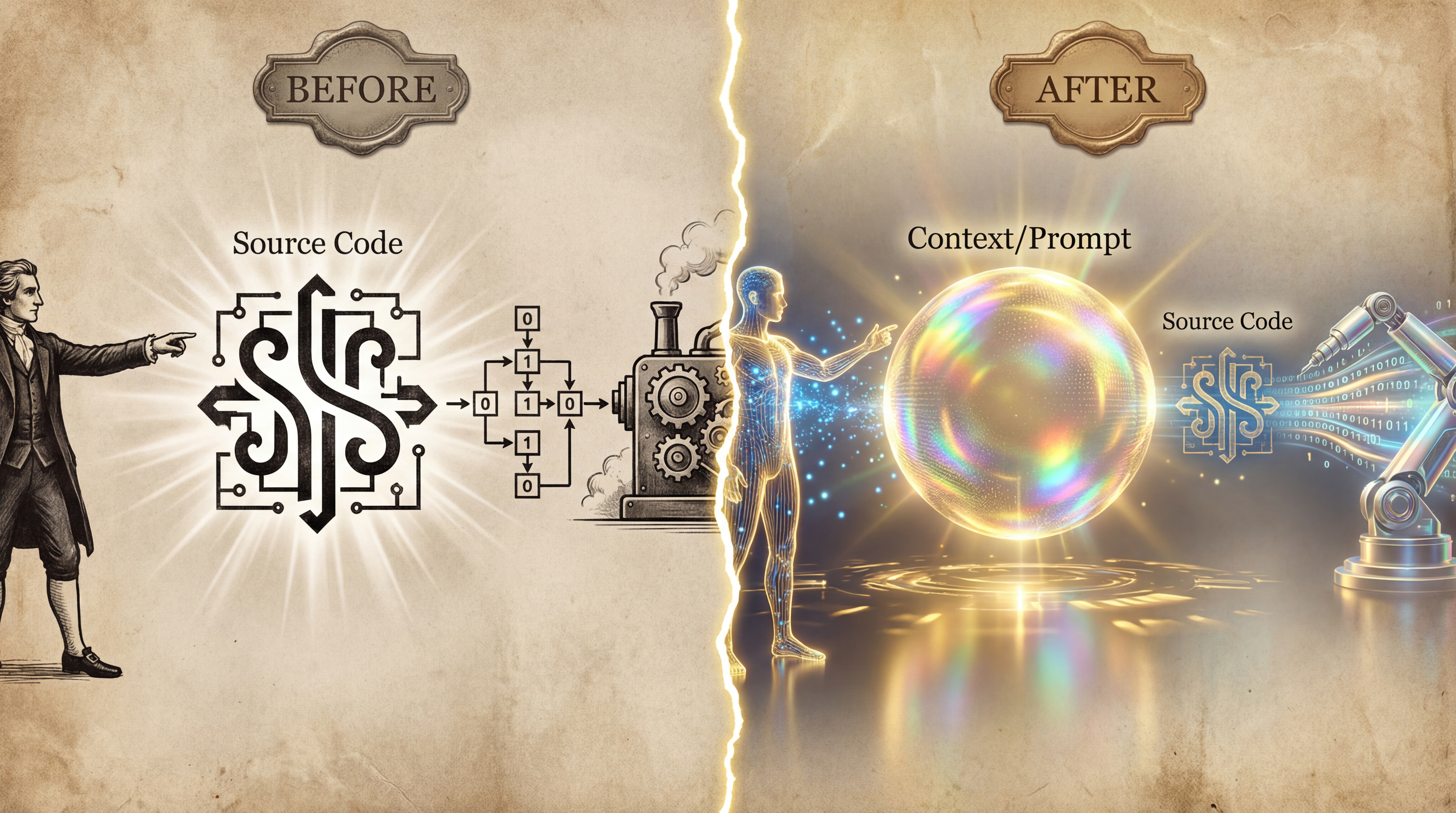
If You Lose the Prompt, You Lose the Source
Imagine if you lost the C source code and were left with only the compiled binary file. Could you maintain it? Theoretically yes (disassembly), but the cost is extremely high.
Similarly, in the AI era, if you lose the Prompt Context that generated the code and are left with only the generated code file. Can you maintain it? You can, but you lose the highest authority to modify it.
When you want to modify the logic, you dare not easily let the AI rewrite it because you don't know what constraints it was generated based on last time. You are forced to degenerate back to manually modifying those complex codes—just like the engineers of yore were forced to manually modify binary files.
Prompt Blame is no longer an auxiliary feature; it is the future git blame. Context Management is no longer an efficiency tool; it is the future file system.
Future Open Source: Open Process
The open-source community is about to usher in a shuffle.
Future high-quality open-source projects will not only publish the v1.0.0 code package but also publish the "Build Context". They will prove:
- This architectural decision was verified through 5 rounds of AI debate.
- This complex regex was generated from a clear natural language description.
Commit Code will become Commit Context.
The responsibility of human engineers will completely transform from "Writer" (the person who writes code) to "Architect" (the person who defines context) and "Reviewer" (the person who verifies results).
Context-Layer Version Control

This is the ultimate mission of the next generation of developer tools.
We need to explore a brand new version control system belonging to the AI era—VCS for Context.
We need a tool that can capture, version, and link those fleeting "thought processes." We need to prove that even in the flood of automated code generation, human "Craft" is still an irreplaceable core asset.
Code-Centricity is ending. Context-Centricity is arriving.
Don't be the person still hand-writing assembly.